Customer acquisition dominates most SaaS growth discussions. Companies invest heavily in marketing, sales, onboarding, and activation funnels, all with the goal of attracting new users. Yet many organisations pay surprisingly little attention to what happens when a customer decides to leave. From an engineering and product perspective, churn is rarely just a commercial problem. More often, it is a product design challenge.
At Software Planet Group, we have spent years building SaaS platforms, business applications, process automation systems, and digital products for organisations operating in a wide range of industries. One pattern appears repeatedly across successful products: customers do not always cancel because they are unhappy.
Projects pause. Budgets are frozen. Teams are restructured. Priorities shift. Market conditions change. A product that was essential six months ago may simply not fit into a customer’s workflow today. Unfortunately, many SaaS products still treat cancellation as a final decision. Users are presented with a cancellation button, subscriptions are terminated, and the relationship effectively ends.
The strongest SaaS products take a different approach. They recognise that customer relationships are rarely linear. Users may reduce usage, pause activity, return later, or expand their engagement as their circumstances evolve. Modern retention is not about preventing customers from leaving. It is about preserving trust, reducing friction, and making future re-engagement as simple as possible.
Subscription Pauses Instead of Permanent Cancellation
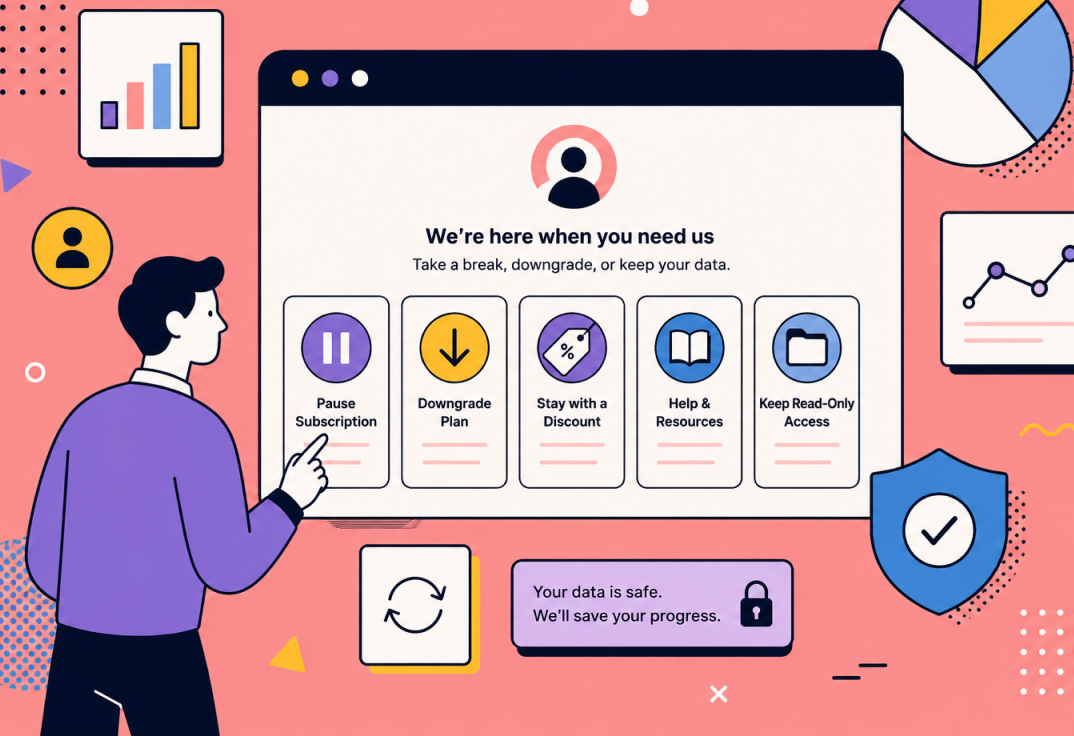
One of the most effective retention mechanisms is allowing customers to pause their subscription rather than cancel it completely. Many users initiate cancellation because they do not currently need the product. That does not necessarily mean they have stopped seeing value in it.
A temporary pause changes the psychology of the decision. Customers can retain their account, workspace configuration, integrations, project history, and stored data without paying during the inactive period. For the customer, this removes the fear of losing previous work. For the SaaS provider, it preserves the relationship and significantly increases the likelihood of future reactivation. This approach is particularly effective for AI platforms, recruitment systems, educational products, analytics tools, and business applications where usage naturally fluctuates throughout the year.
In many situations, maintaining a dormant relationship is far more valuable than collecting one final monthly payment before losing the customer entirely.
Using Retention Discounts Strategically
Temporary retention discounts can also be highly effective when applied carefully. After a customer has already indicated a genuine intention to leave, offering a short-term discount may be commercially sensible. In many cases, retaining an existing customer at a reduced rate is significantly less expensive than reacquiring them later through advertising, sales efforts, onboarding programmes, and customer success initiatives. However, timing matters.
When discounts appear too early in the cancellation process, customers quickly learn that threatening to cancel results in lower pricing. Over time, this behaviour can undermine the entire pricing model. The most effective retention discounts are targeted, temporary, and offered only after genuine cancellation intent has been established.
This strategy works particularly well when customer acquisition costs are high and onboarding requires meaningful investment from both the customer and the provider.
Offering Downgrades Instead of Losing Customers
Not every customer who leaves wants to leave completely. Very often, businesses simply require less functionality than they previously did. Rather than forcing users into an all-or-nothing decision, SaaS platforms can offer lower-tier plans with reduced limits, fewer active users, restricted functionality, or read-only access. For example, a company that previously required twenty active licences may currently need only five. Allowing customers to scale down while preserving workflows, integrations, and historical data creates a far more flexible experience.
From the customer’s perspective, this feels commercially reasonable. From the provider’s perspective, it prevents complete churn and keeps the customer within the ecosystem. Temporary downsizing is frequently healthier for both sides than forcing a full cancellation.
Converting Passive Users Through Card-Verified Trials
Free plans remain one of the most effective customer acquisition mechanisms in SaaS. However, they often attract large numbers of users who never fully engage with the product. Many organisations have experienced the challenge of maintaining thousands of registered users who rarely explore advanced functionality and show little intention of upgrading.
One solution is to identify active free users and offer premium trial access that requires payment card verification before activation. This simple step changes user behaviour considerably. Once users connect a payment method, they become more likely to integrate the product into real workflows, explore advanced features, complete onboarding activities, and develop long-term usage habits. The objective is not to trap customers into unexpected payments. Transparent billing and simple cancellation processes remain essential. Instead, the goal is to ensure that users experience the product’s full value before making a long-term purchasing decision.
This approach often performs particularly well for AI tools, developer platforms, workflow automation systems, and productivity products where habit formation is a key driver of retention.
Maintaining Read-Only Access After Cancellation
One of the simplest and most overlooked retention strategies is allowing customers to retain access to their data after cancelling. Many platforms immediately lock users out or remove access to historical information. While this may appear to encourage renewals, it often creates frustration and damages trust. A more effective approach is to move cancelled accounts into a read-only state.
Users can continue viewing projects, reports, historical records, dashboards, and archived workspaces without being able to modify content or create new records. This creates a significantly softer exit experience.
More importantly, it reduces the psychological barrier to returning because customers never feel that they have completely abandoned the platform. Interestingly, products that make it easier to leave often find it easier to attract customers back in the future.
Building Intelligent Cancellation Flows
Traditional cancellation forms typically provide little more than a confirmation screen. Modern SaaS products can do considerably better. Instead of presenting every customer with the same generic process, platforms can adapt the experience based on the reasons for cancellation. If cost is the primary concern, a downgrade option or temporary discount may be appropriate. If inactivity is the issue, a subscription pause may be a better fit. If onboarding difficulties are driving dissatisfaction, additional guidance, training materials, or implementation assistance may help resolve the problem. If missing functionality is the concern, roadmap visibility or access to upcoming features may influence the decision.
The key principle is simple: understand the customer’s situation and respond intelligently. This should never feel manipulative. Customers quickly recognise aggressive retention tactics and dark patterns. Effective retention is based on relevance, not pressure.
Retention Starts Long Before Cancellation
The most successful SaaS products do not wait until customers reach the cancellation screen. Instead, they monitor engagement signals continuously. Declining activity, reduced feature adoption, inactive workspaces, falling usage frequency, and incomplete onboarding journeys often provide early indicators that a customer relationship is weakening.
By identifying these signals early, organisations can intervene proactively through education, onboarding assistance, plan optimisation, workflow recommendations, or targeted support. This approach is typically far more effective than attempting to rescue the relationship during the final cancellation step.
In practice, retention is rarely solved on the cancellation page itself. It is solved through ongoing value delivery, customer success, product usability, and subscription models that adapt to changing customer needs.
Building SaaS Products That Customers Want to Return To
Strong SaaS businesses understand an important principle: not every departing customer is truly lost. Business priorities change. Teams evolve. Funding cycles fluctuate. Internal projects pause and restart. Customers frequently return when products preserve trust and avoid turning cancellation into a hostile experience. Aggressive retention tactics may improve short-term metrics, but they often damage long-term relationships. The most resilient SaaS platforms focus instead on flexibility, continuity, and customer-centric product design.
At Software Planet Group, we view retention as a product capability rather than a marketing tactic. Features such as subscription pauses, intelligent cancellation flows, downgrade paths, read-only access, and proactive engagement mechanisms are examples of thoughtful product design that benefits both users and providers. The strongest SaaS products are not the ones that make it difficult to leave. They are the ones customers choose to return to.