Introduction
The AI industry has spent the last two years competing to build models with ever-larger context windows. What started with a few thousand tokens has grown into hundreds of thousands and, in some cases, millions of tokens.
At first glance, this appears to solve one of the biggest challenges in AI: analysing large codebases, enterprise documentation, legal contracts, research archives, and business knowledge repositories. If a model can read everything at once, surely it should be able to understand everything as well.
However, practical experience increasingly suggests that larger context windows do not automatically produce better reasoning.
At Software Planner Group (SPG), a London-based software development company specialising in complex SaaS platforms, enterprise software systems, and AI-powered products, we regularly encounter this challenge. As organisations attempt to process growing volumes of source code, operational data, technical documentation, and business knowledge, simply increasing the amount of information available to a model is often not enough.
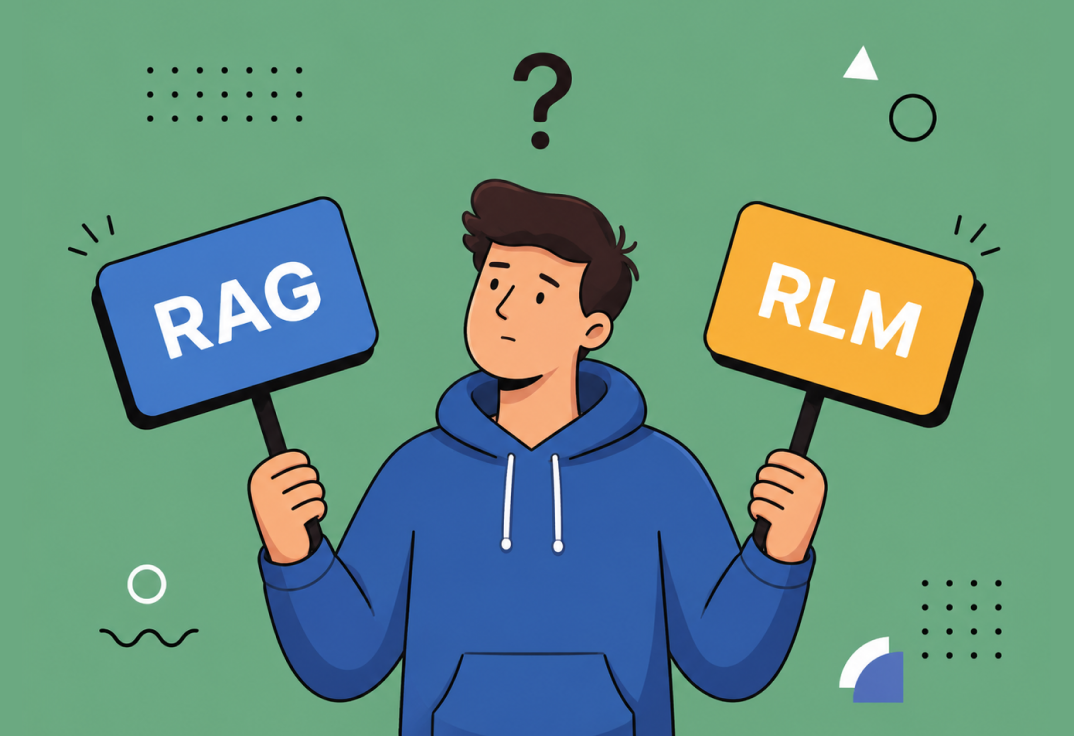
The industry’s first response to this problem was Retrieval-Augmented Generation (RAG). More recently, researchers have proposed a different approach known as Recursive Language Models (RLMs). While both approaches aim to help AI systems work with large amounts of information, they solve fundamentally different problems and rely on very different architectural principles.
The Long-Context Problem
Modern language models can theoretically process enormous amounts of information. Yet many developers have observed that reasoning quality often declines as context grows.
The issue is not necessarily context capacity. The issue is attention. Transformer architectures must distribute attention across all information present in the prompt. As datasets become larger, identifying meaningful relationships between pieces of information becomes increasingly difficult. Models may retrieve facts correctly while simultaneously struggling with aggregation, counting, comparison, dependency analysis, or multi-step reasoning.
This explains why a model may perform well when analysing a small document but struggle when asked to understand a large software repository, a lengthy contract, or an extensive collection of business documents. The information may fit within the context window, but that does not guarantee that the model can reason effectively across all of it.
As a result, simply increasing the context window does not eliminate the underlying architectural challenge.
What Is RAG?
Retrieval-Augmented Generation has become the dominant architecture for enterprise AI applications.
The process is relatively straightforward. Documents are divided into smaller chunks, and each chunk is converted into a vector representation using an embedding model. These vectors are stored in a vector database.
When a user submits a query, the query is also transformed into an embedding. The vector database retrieves the most similar chunks, and those chunks are inserted into the prompt sent to the language model. The model then generates an answer using the retrieved information.
Conceptually, RAG combines semantic search with natural language generation. Instead of asking the model to read an entire knowledge base, the system retrieves only the fragments that appear relevant to the question being asked.
At SPG, we actively use Retrieval-Augmented Generation in client projects involving knowledge management systems, internal documentation search, support automation, compliance workflows, AI assistants, and enterprise search platforms. In these scenarios, RAG provides an excellent balance between implementation complexity, operational cost, and response quality.
For many business applications, RAG remains one of the most practical and cost-effective approaches available today.
Why RAG Became the Industry Standard
RAG offers several important advantages that explain its widespread adoption.
First, it is fast. Only a small subset of the available information needs to be processed for each request. Second, it is relatively inexpensive because token consumption remains low compared to brute-force long-context prompting. Third, it scales effectively to large document collections without requiring every document to be included in every prompt.
RAG also reduces hallucinations when relevant information exists within the indexed dataset. Instead of relying entirely on the model’s training data, responses can be grounded in specific documents controlled by the organisation.
For customer support systems, FAQ assistants, internal knowledge bases, policy repositories, and static documentation platforms, these characteristics make RAG extremely attractive.
Where RAG Begins To Show Limitations
The fundamental limitation of RAG is that retrieval is not reasoning.
RAG excels at finding information that appears relevant to a question. However, many real-world business problems require significantly more than information retrieval. Tasks involving aggregation, counting, pairwise comparison, dependency analysis, architectural investigation, root-cause discovery, or strategic decision support often require a deeper understanding of relationships across an entire dataset.
There are also operational considerations. Whenever source data changes, embeddings may need to be regenerated. Switching to a newer embedding model may require reprocessing the entire knowledge base. Changes to chunking strategies can force additional reindexing. Vector databases introduce another layer of infrastructure that must be maintained, monitored, and scaled.
In practice, the most difficult AI projects are rarely retrieval problems. They are reasoning problems. As a software development consultancy focused on solving complex engineering and business challenges, we frequently encounter scenarios involving large codebases, interconnected business processes, operational data analysis, and decision-support systems. These are precisely the situations where traditional retrieval approaches begin to reveal their limitations.
What Is a Recursive Language Model?
Recursive Language Models take a fundamentally different approach.
Instead of relying primarily on a pre-built retrieval layer, an RLM treats the language model as an active investigator. Rather than asking the model to consume retrieved information, the architecture allows the model to explore, analyse, and reason about data using tools and code.
The core idea is relatively simple. Data remains outside the model and is accessed through a controlled interface. The model writes code, executes analysis, reviews results, and decides what to investigate next. When additional reasoning is required, it can delegate parts of the problem to specialised sub-models operating with clean context windows.
These sub-models return conclusions to the parent model, which combines them into a broader understanding of the problem. A separate aggregation model then produces the final response.
The objective is not simply to locate relevant information. The objective is to build a structured reasoning process capable of understanding complex systems.
How Recursive Reasoning Works
The recursive workflow resembles the way experienced engineers approach difficult technical problems.
When analysing a large software platform, nobody attempts to understand every file simultaneously. Instead, engineers break the problem into smaller parts, investigate each component independently, and gradually build a coherent understanding of the system.
An RLM follows a similar process. The primary model begins by exploring the available information. It may inspect repository structures, query databases, analyse logs, review documentation, or execute custom code. When it encounters a particularly complex area, it delegates that investigation to a specialised sub-model operating with a clean context window.
Each sub-model focuses on a narrow problem and returns concise findings. The parent model then combines these findings into a broader understanding of the system. This process continues until sufficient confidence is achieved or a predefined recursion limit is reached.
Finally, a dedicated aggregation model produces a structured response for the user.
The distinction is important. Traditional RAG systems retrieve information that appears relevant to a query. Recursive Language Models go further by actively investigating the available data, generating intermediate analyses, and combining findings into a broader understanding of the system being examined.
A Practical Software Engineering Example
Imagine joining a project containing 800 source files.
Traditional prompting quickly reaches practical limitations. Even models with large context windows struggle to maintain a coherent understanding of the entire repository.
A Recursive Language Model could approach the same problem differently. It might begin by analysing the repository structure and identifying the most important directories. It could then examine Git history to locate files with unusually high change frequency and identify potential architectural bottlenecks, unstable modules, or areas containing concentrated business logic.
The system could subsequently launch specialised analyses for each critical component, reviewing implementation details, commit history, ownership patterns, dependency structures, and recent modifications. These individual investigations would then be combined into a comprehensive report highlighting architectural risks, recommended refactoring targets, onboarding priorities, and areas requiring immediate attention.
This approach resembles an engineering investigation rather than a document retrieval exercise.
The MIT Research Behind The Recent Interest
Much of the recent attention surrounding Recursive Language Models comes from research conducted at MIT.
The researchers argued that many popular long-context benchmarks primarily test retrieval rather than reasoning. One example is the well-known Needle in a Haystack benchmark. Finding a specific fact hidden within a large context demonstrates retrieval capability, but it does not necessarily demonstrate deep reasoning.
To address this limitation, the researchers introduced a benchmark called LongPairs.
The benchmark was constructed using approximately 500 records from the TREC Question Classification dataset. Each record belongs to one of six categories: Person, Location, Number, Abbreviation, Entity, or Description.
The challenge was not to classify individual records. Instead, models had to analyse every possible pair of records and answer questions involving aggregation across the entire dataset.
With 500 records, there are 124,750 unique pairs. Answering these questions requires large-scale comparison and aggregation rather than simple retrieval. The computational complexity grows quadratically as the dataset expands, creating a significantly more demanding reasoning task.
The Results
According to the presentation, GPT-5 operating directly on the dataset achieved approximately 1% accuracy on the LongPairs benchmark.
Importantly, the dataset itself contained only around 32,000 tokens, which is well below the model’s context limit. The failure was therefore not caused by insufficient context capacity. Instead, it appeared to stem from the complexity of the reasoning task itself.
When the same model was wrapped in a Recursive Language Model architecture, accuracy reportedly increased to approximately 58%.
No retraining was required. No model weights were modified. The improvement came entirely from changing the way the model interacted with information.
While further independent validation of these results remains valuable, the research highlights an important observation: system architecture may be just as important as model capability when solving complex reasoning problems.
Cost Considerations
One of the more surprising aspects of the RLM approach is that it can sometimes be cheaper than brute-force long-context prompting.
Traditional prompting requires the model to process every token presented in the context window. Recursive architectures investigate only the information necessary to answer the question. Rather than reading an entire dataset, the model selectively explores relevant areas and performs targeted analysis.
As a result, an RLM may consume significantly fewer tokens while producing more accurate results. This can reduce computational cost while simultaneously improving reasoning quality.
The exact economics depend on the use case, but the broader principle is clear: intelligent investigation can often be more efficient than attempting to process everything at once.
Why Hybrid Architectures Are Likely To Win
From our perspective, the future is unlikely to belong exclusively to either RAG or RLM.
Enterprise AI systems are increasingly evolving into complex software platforms that combine multiple architectural patterns. Retrieval-Augmented Generation, Cache-Augmented Generation (CAG), memory systems, tool calling, code execution, vector search, and recursive reasoning each address different aspects of the broader problem.
The engineering challenge is no longer selecting a single AI architecture. The challenge is designing systems that intelligently combine these capabilities in ways that produce reliable business outcomes.
In many future systems, RAG will remain responsible for efficient retrieval, while recursive reasoning components will handle investigation, aggregation, planning, and decision support. Rather than competing with each other, these approaches are likely to become complementary parts of larger AI platforms.
What This Means For Businesses
Organisations investing in AI should be cautious about viewing larger context windows as a complete solution.
The most successful AI systems are increasingly being built as engineered platforms rather than simple chatbot interfaces. Many of the challenges encountered in production environments involve architecture, data quality, integration, observability, governance, scalability, and operational reliability rather than model selection alone.
At Software Planner Group, we see growing demand for AI solutions capable of analysing software systems, business processes, enterprise knowledge, operational data, and proprietary information assets. Building these systems requires expertise not only in AI models but also in software architecture, DevOps, cloud infrastructure, quality engineering, distributed systems, and product development.
Organisations often focus heavily on AI models themselves, but successful AI initiatives usually depend on the surrounding engineering architecture. Data pipelines, software architecture, integration strategy, observability, quality assurance, security, and operational processes frequently have a greater impact on business outcomes than the choice of model alone. For this reason, advanced AI systems should be viewed as engineering projects rather than model selection exercises.
Conclusion
Retrieval-Augmented Generation solved the first generation of enterprise AI challenges by giving language models access to external knowledge.
Recursive Language Models attempt to solve the next generation of challenges by enabling models to investigate, decompose, and reason about complex datasets autonomously. While RAG remains an excellent solution for information retrieval, RLM architectures appear particularly promising for scenarios requiring aggregation, investigation, analysis, and multi-step reasoning across large information spaces.
For organisations building advanced AI products, the discussion is gradually shifting away from choosing a single architectural pattern. The more important challenge is understanding how retrieval, memory, tool usage, code execution, and recursive reasoning can be combined into a coherent system that delivers reliable business outcomes.
At SPG, we believe the next wave of AI innovation will come not from larger context windows alone, but from better system architecture, stronger engineering practices, and more sophisticated ways of combining AI capabilities to solve real business problems.