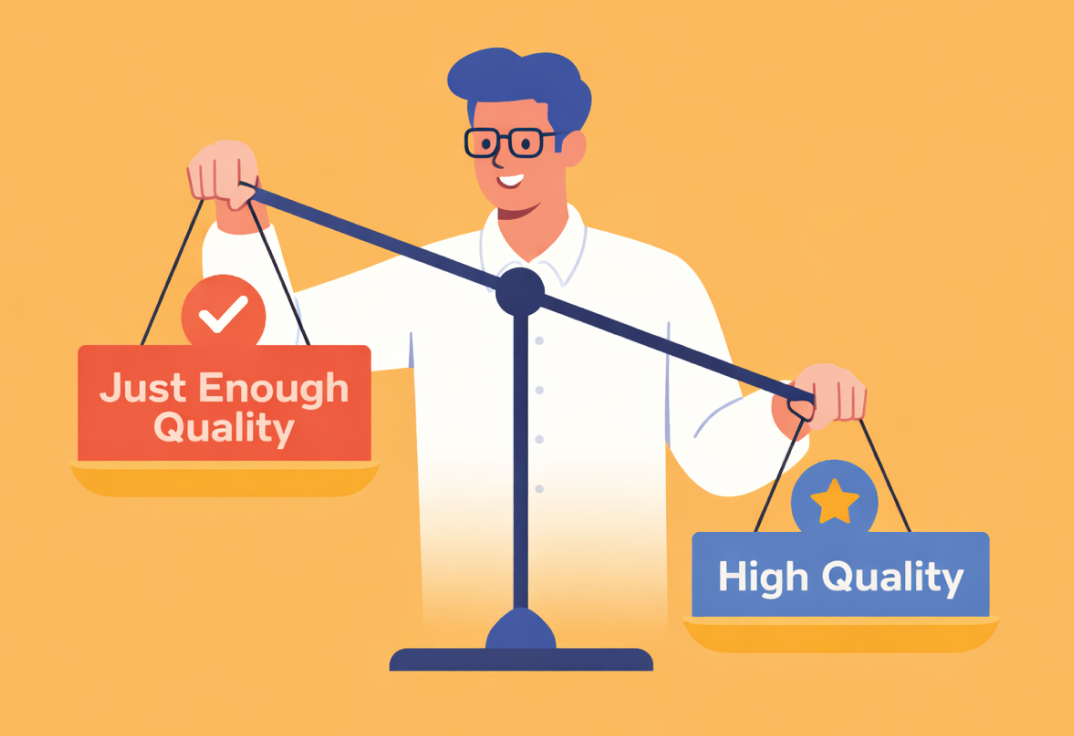
At a recent kickoff meeting, a client said something that most vendors do not expect to hear. He did not want “top-tier quality”. What he wanted was stability. Predictability. No situations where development stops and the team is forced into endless defect fixing. That single remark revealed a mature understanding of how real software systems are built and, more importantly, how they fail.
This is where the conversation about quality becomes uncomfortable but necessary.
Quality Is Not a Linear Investment
There is a persistent illusion in software development that quality scales proportionally with effort. In reality, it behaves more like an exponential curve.
Improving quality from poor to acceptable is relatively cheap. Teams introduce automated tests, basic CI/CD pipelines, code reviews, and suddenly defect rates drop dramatically. This is the low-hanging fruit.
But once you reach a stable baseline, every additional improvement becomes disproportionately expensive. Moving from “good” to “very good” might double the effort. Moving from “very good” to “near-perfect” can multiply costs several times over, while delivering marginal business value.
In practical terms, if reaching a solid, production-ready system costs X, then squeezing out the next incremental improvement may cost 2X or even more. The return on that investment rarely justifies the spend.
What “Just Enough Quality” Actually Means
The phrase can sound like compromise, but in reality it is a strategic decision.
“Just enough quality” is not about cutting corners. It is about deliberately defining the point at which the system is:
- stable under expected load
- resilient to common failure scenarios
- testable and maintainable
- free from critical defects that block business operations
At this level, the product can evolve safely. The team does not stop to firefight. Development continues, features are delivered, and the system improves iteratively.
Anything below this threshold is dangerous. The product becomes fragile, technical debt accumulates, and eventually the team is forced into a costly stabilisation phase.
Anything far above this threshold is often wasteful. Teams over-engineer, over-test, and over-optimise areas that bring little real business impact.
The Two Extremes That Kill Projects
From years of working with different clients and systems, the pattern is consistent.
The first extreme is underinvestment in quality. The product ships quickly but becomes unstable. Defects pile up. At some point, progress halts because every new feature introduces regressions. The team enters a cycle of constant repair.
The second extreme is overinvestment. The team chases architectural purity, near-perfect test coverage, and theoretical edge cases. Delivery slows down. Budgets inflate. Time-to-market is lost.
Both scenarios lead to the same outcome: reduced business value.
The client in that kickoff meeting was explicitly trying to avoid both.
Where Experience Makes the Difference
Teams that have lived through multiple product lifecycles recognise this balance early.
Practices such as TDD, pair programming, continuous refactoring, and incremental delivery, which we have been applying since the early days of Extreme Programming, are not about maximising quality at all costs. They are about controlling it. Keeping it within a safe, efficient range.
This aligns directly with the idea of focusing on outcomes rather than ideology. Quality is not a goal in isolation. It is a constraint that must support business objectives.
A More Useful Definition of Quality
Instead of asking “How high can we push quality?”, a better question is:
“What level of quality allows us to move forward without interruption?”
That shift changes everything. It reframes quality from a technical ambition into a business enabler.
It also creates a more honest partnership between client and vendor. Expectations become explicit. Trade-offs are discussed openly. And most importantly, the team avoids the trap of solving the wrong problem perfectly.
Closing Thought
High quality is not inherently valuable. Appropriate quality is.
The strongest teams are not those who aim for perfection, but those who know exactly where to stop.
If you are planning a new product or struggling with an existing one, it is worth stepping back and asking whether your current approach to quality is enabling progress or quietly blocking it. That conversation alone often saves more time and money than any optimisation effort.